
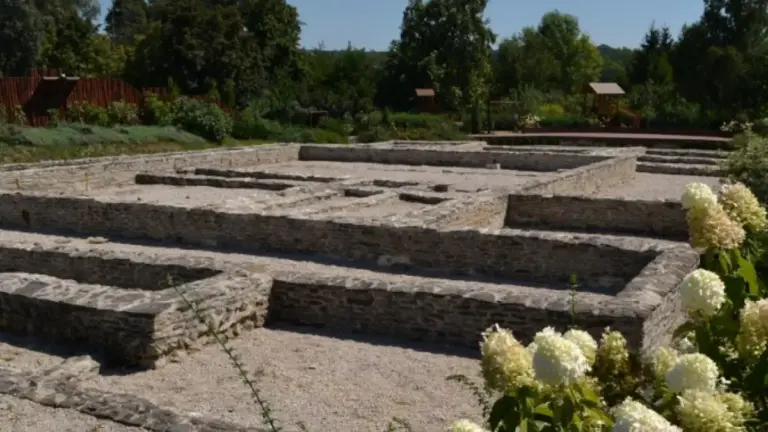
Roman-era ruin garden
The Roman-era ruin garden at the end of Attila utca has been completely renovated. In the well-kept setting, interactive programmes and new services also await visitors at the historical monument.
At the turn of the 1st and 2nd centuries, a large stone building was erected in its place, which was 45 m long and almost 23 m wide — thus more than 1,000 square metres in floor area. The building, provided with a porticus (a columned porch) on the eastern side, also had hot, warm and cold-water bathing pools. Despite this, it is not certain that the building was the residential building of the villa estate (villa urbana), since no trace of central heating was found. (In earlier statements, from 2001, the existence of central heating was still assumed!)
The building was presumably destroyed towards the end of the 2nd century, but in the 3rd century it was rebuilt with a different internal layout, and a Mithras sanctuary was even created within it. The foundation stone of the altar was found during the excavation. The sanctuary and the building were demolished in the 4th century, but were soon rebuilt, until they were finally destroyed at the beginning of the 5th century. The function of the facility is uncertain in this period too; it was presumably used for some kind of economic activity.
The stone building, which went through three construction periods, was excavated in 2001 and 2003 under the direction of Dr. Róbert Müller. (See the "Hévíz" journal, 2004, issue 1, Róbert Müller's study titled "Római-kori épület feltárása Hévíz Egregy városrészében" / "Excavation of a Roman-era building in the Egregy district of Hévíz".) The excavations and the restoration cost a total of more than 10 million forints, towards which the Ministry of National Cultural Heritage provided 5 million forints in support, while the remainder was provided by the Municipality of the Town of Hévíz.