
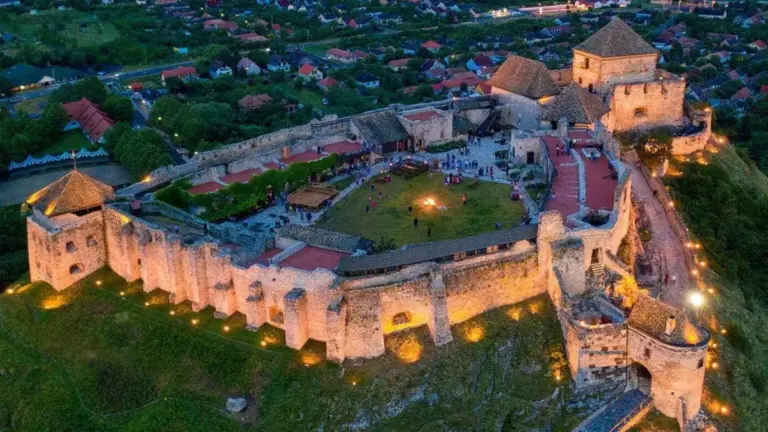
Sümeg Castle
Sümeg Castle is one of the country's most beautiful and relatively well-preserved medieval fortresses, built on a bare hilltop that rises high above its surroundings.
The castle consists of three larger units: the outer, the inner and the upper castle (citadel). Its construction can be divided into several periods. The oldest part of the castle was built in the 1260s — the lower level of the citadel's Old Tower (keep), on which a wooden upper tower section may once have stood.
A change came about in the 14th century, during the time of the Angevin kings. It was then that, alongside the strengthening of the castle, the walls of the citadel and the upper level of the Old Tower (keep) were built and the existing buildings repaired.
The major extensions of the castle were carried out during the 15th century, in the times of the bishops Mátyás Gathalóczy (1440–1457), Albert Vetési (1458–1486) and then János Vitéz the Younger (1489–1499). First, the larger plateau in front of the small castle was surrounded with a high castle wall, creating a large courtyard.
During Bishop Vetési's activity, the Inner Gate Tower was built and the palace was completed on the southern rocks of the castle. The Outer Gate Tower and the crenellated, loopholed castle wall date from a later period. The creation of the chapel can be linked to the name of Bishop János Vitéz.
The next large-scale construction began after Veszprém fell into Turkish hands in 1552 and the bishopric fled to Sümeg Castle. The works were carried out under the direction of Bishop András Köves (1553–1568) and castle captain Józsa Ormányi. First, a two-storey, large bastion with a pentagonal ground plan was built at the northern corner of the castle, which was later named after Bishop Köves; then the palace wing was rebuilt.
The elevation of Sümeg Castle to an episcopal seat is linked to the name of Bishop György Széchenyi (1648–1658), and it was he who also initiated the Baroque-style transformation of the palace wing.
His successor, Bishop István Sennyei (1659–1683), continued the construction of the castle: the Outer Gate Tower was reinforced, and a tall bastion bearing the bishop's name was added beside it.
The history of the castle's construction ends with the episcopate of Bishop Pál Széchenyi (1687–1710). At that time, besides repairs, further construction could also take place. The castle's decline began at the start of the following century. After Rákóczi's War of Independence, it was set on fire in 1713, and from then on the castle was exposed to ruin for two and a half centuries.
The history of the castle's construction ends with the episcopate of Bishop Pál Széchenyi (1687–1710). At that time, besides repairs, further construction could also take place. The castle's decline began at the start of the following century. After Rákóczi's War of Independence, it was set on fire in 1713, and from then on the castle was exposed to ruin for two and a half centuries.
In 1989, the Papp family applied to operate the castle. In the first years, they began clearing the ruins and restoring the life-threatening and accident-prone areas. With the permission of the National Office for the Protection of Monuments, renovation works also began in the castle. The castle's towers received new roofing, and the halls were enriched with more and more high-quality exhibitions. Thanks to the tourism programmes held in the castle and to the continuous developments, Sümeg Castle has today become one of the most popular excursion destinations among tourists in Hungary.