
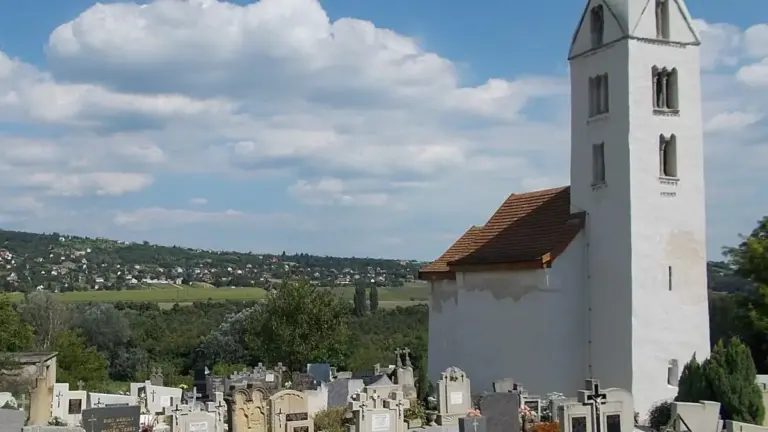
Árpád-era (Egregy) church
The church with the oldest past in Hévíz is the Árpád-era church dating from the 13th century, located in the Egregy district.
The exact time of the church's construction is not known; it was probably built around the middle of the 13th century. It is first mentioned in written records in 1341. The building was severely damaged in the 16th–17th centuries, and was later renovated in the Baroque era, in 1731. Fortunately, during the alteration only the most essential repairs were made, so the church's medieval form was preserved. During this renovation, the internal and external decorative paintings and the raising of the nave were carried out, and the vaults were also replaced. The church's first patron saint was St Catherine of Alexandria. After the reconstruction it was reconsecrated, and its new patron saint became St Magdalene. After this, the church was restored several more times: in 1860, 1912, 1964–65, 1990 and 1991, and most recently in 2015.
On the southern side we find a Baroque door that was opened there. The tower's vault was renewed in the 18th century, and a rectangular nave adjoins it. Inside the church, the only decorative, space-enriching element is the row of niches on the northern wall.
We must mention the church's wall painting. It is not of medieval origin, but is an ornate proof of the church's architectural enrichment. It demonstrates respect for the folk repertoire of forms. Inside the building there is a fragment of a baptismal font from the Romanesque period, as well as a medieval consecration cross.
The church has a straight-ended sanctuary, is single-naved and east-oriented, and its spatial structure is easy to survey. Its tower has three storeys and a rich design; on the levels, double and triple twin windows open. The tower is closed off by a spire (csűrlős sisak) stiffened by eight wooden beams.
In terms of its foundations, it has mainly preserved the forms of timber architecture. On the external surfaces, the painted decorations and incised forms have survived.