
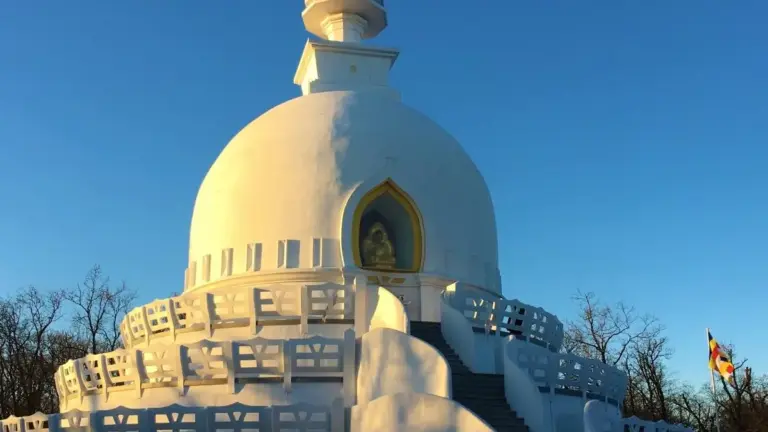
Buddhist Stupa
Bop Jon (Jin Soo Lee), a South Korean Buddhist monk, decided to build, in Hungary or in the Czech Republic, a Buddha shrine that represents the symbol of peace, happiness and enlightenment. He decided in favour of our country, searching for a suitable place in the Balaton Uplands. Even after a long search, he did not find a place where the population would reassuringly accept the "sacred" building of an Asian religion. Following the elections of October 1990, the village's mayor offered the construction of the stupa on the administrative territory of Zalaszántó.
This, however, was preceded by topographical research, which revealed that peoples of other cultures had not previously built on the hill called Világosvár and had left no heritage there. The Bishop of Veszprém also took note of and accepted the building of the shrine.
The construction was preceded by about a year by a ceremony, at which they sought the spirit of the Earth and thereby designated the place of the stupa; then, with the cordial support of the Hungarian state, the construction of the stupa began.
The construction cost was raised mainly from the donations of the South Korean people, as well as from the donations of Austrian people (about 40 million forints). The execution was carried out by Hungarians. In the building, 24 metres in diameter and 30 metres high, an earthly relic of Buddha was placed, which came from the Tibetan Potala Palace to India — to the place of exile of the current Dalai Lama — and from there to the Buddhist school in Switzerland.
The mayor made sure from the very beginning that the shrine was being built with the Dalai Lama's knowledge. They even met in Vienna, and thanks to skilful diplomacy, the building erected for world peace was inaugurated in person by the 14th Dalai Lama (Tenzin Gyatso) on 17 June 1993.