
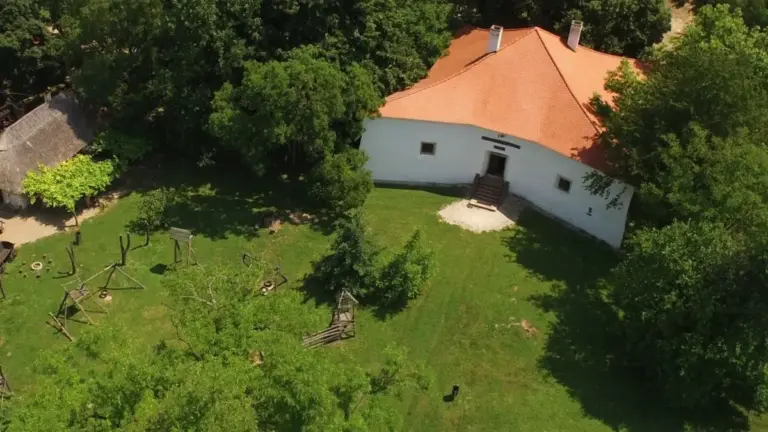
Star Castle (Csillagvár)
The history of the Star Castle
In the western corner of Lake Balaton, on a wooded hillside rising above the lake, stands the hunting castle of the Festetics counts. The star-shaped building is unique in the world. In the central room of the roofed castle are the more than thirty-metre-deep well, the captain's, the guard's and the rest rooms, the smoky kitchen, etc. Here the medieval-life waxworks found their place, faithfully presenting a day of the past. (A castle captain arguing with a village priest, feasting warriors, soldiers on guard duty, a village blacksmith just pulling a tooth, women busying themselves in the kitchen, etc.)
In the casemates (cellar system) with a Greek-cross ground plan, the world's unique hussar museum found its place. A hundred and fifty 80 cm tall hussars give a picture of the ornate attire of our light cavalry of the past; but we can also see, arranged in chronological order, the Hun-Hungarian warriors and the medieval lords. The row is closed by the soldiers of the First World War.
On the nearly one-and-a-half-hectare enclosed area, an art creative camp opens its doors from 2006. The inn (csárda), created from the former count's stable, also welcomes its guests, and the open-air stage under construction will be the venue for the "Csillagvár Evenings" (Star Castle Evenings) event series.
The Hungarian nation lived its heroic age in the 16th–17th centuries, when the fight against the expanding Ottoman power went on for a century and a half. By the end of the 1500s, the line of border fortresses in Transdanubia was formed by the southern shore of Lake Balaton, and so Somogy County became the scene of constant heroic battles. The building rises about 40 m above Lake Balaton. It has strangely sloping-planed walls, a star shape, loopholes, a drawbridge mechanism, wall remains pointing to a former tower, an internal well, minaret-like sandstone spiral staircases leading from the cellar to the attic, and corner-bastioned ramparts. Its cellar is in the shape of a Greek cross. Its architectural solution is unique in the world. The legend of the suicidal bridegroom and bridesmaid, as well as of the outlaw-hiding caves, is connected to its well, but of the tragedy of the well-diggers we could only learn from later archival research. The building demonstrably had no roof structure originally, and when the wall remains of the central tower came to light during the restoration, it became beyond doubt that it may have had a tower.
During the excavations it turned out that on the area of the castle and the ramparts there had been a settlement of timber-framed mud huts, which was destroyed when Kanizsa fell into Turkish hands. The tunnel system that occurs so often in the legends was not found. The exploration of the castle's history is owed to Béla Móricz, but István László — who was born in the Captain's room at the turn of the century — also has great merits.