
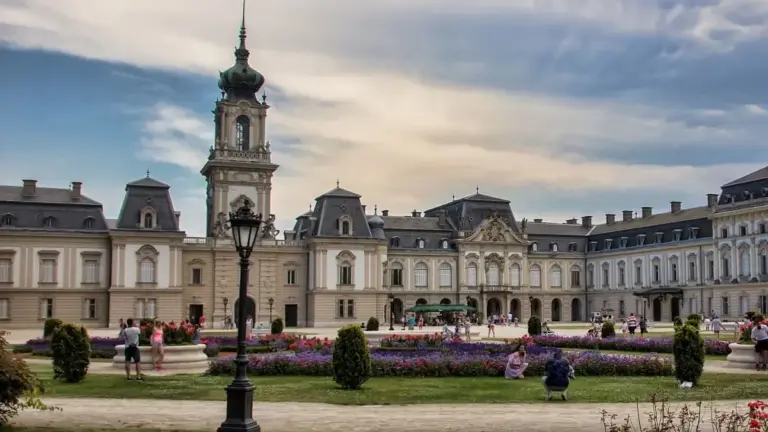
Helikon Palace Museum
Back into the past? You can gain an insight into the mysteries of the aristocratic way of life within the framework of the permanent exhibitions.
The Helikon Library, hunting, carriage and model railway exhibitions, as well as a palm house and a bird park, welcome the visitor.
The interior exhibition, comprising more than twenty rooms of the palace, presents the 18th–19th-century aristocratic way of life to visitors through original or period-faithfully reconstructed interiors. The presentation of the palace building — erected by the Festetics family in several construction periods between 1745 and 1887 — and of its former furnishings is possible because, compared with other Hungarian palaces, all of these have survived to a great extent in their original form.
The Festetics family was one of Hungary's most significant aristocratic families (of count, and later prince, rank) for two centuries. They chose the furnishings of their Keszthely palace with great care and discernment. The first two generations living in the palace — Kristóf Festetics and Pál Festetics III — furnished the Baroque palace, built between 1745 and 1750, with Baroque and Rococo objects respectively. The collection's oldest pieces of furniture and paintings date from this period. The Classicist and Empire-style furniture and decorative objects of the collection preserve the period of the palace's rebuilding and expansion between 1792 and 1804, associated with the name of György Festetics I.
The palace acquired its present form during the transformation under Tasziló Festetics II, between 1883 and 1887. A significant part of today's art collection is connected to Tasziló and his wife, the Scottish duchess Lady Mary Hamilton. Besides the architectural and interior-design transformation of the palace, the range of furnishings also changed and was expanded at this time. On the one hand, the firm Portois & Fix, which carried out the interior-design work, not only restored the existing furniture but also manufactured numerous new furnishings for the palace, which today likewise form part of the collection.
On the other hand, according to tradition, Mary Hamilton arrived into the marriage and to Keszthely with a trainload of furnishings, which strongly defined the palace's interiors. She brought with her mainly French Rococo and Classicist, as well as English Classicist, furniture, which she may have inherited partly from her paternal grandmother, Susan Beckford, daughter of the famous English art collector William Thomas Beckford; and partly came into her possession through her maternal grandmother, Stéphanie de Beauharnais, Napoleon's adopted daughter. Besides the furniture, portraits of Mary's family — paintings and sculptures depicting members of the Hamilton and the Baden families — also decorated, and still decorate, the rooms of the palace. Tasziló and Mary enriched their palace with numerous further works of fine art, so their own portraits and paintings depicting the family's horses also enrich the collection.