
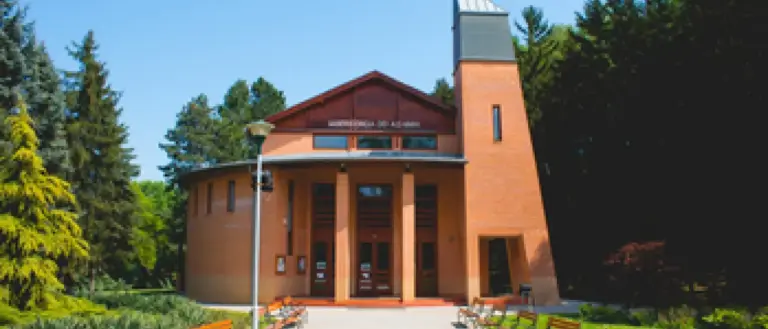
Divine Mercy Church
Béla Balás, diocesan bishop of Kaposvár, elevated Zalakaros to the rank of parish on 27 April 2014, Divine Mercy Sunday, separating it from the territory of the Galambok Parish. One reason for the foundation is that Zalakaros had administratively become a town and a tourist centre. The beginning of the parish's operation coincided with the day of the canonisation of Popes John Paul II (the founder of the Diocese of Kaposvár and the one who instituted Divine Mercy Sunday) and John XXIII. The parish church of the new parish became the Divine Mercy Church. As to why it was only elevated to parish rank now, the reason can be found in the settlement's past, for Karos — and later Zalakaros — was a tiny little Zala village for centuries.
The Zalakaros church community has operated since 1802 as a filial church community of the Galambok Parish (source: NOVÁK, F., Plébánosok Zalakaroson, manuscript, Zalakaros 2010), becoming increasingly independent of the mother church. The reason for this lies in the wonderful natural gift of the settlement — which now boasts town rank — namely that it is also a spa town, attracting many visitors from afar. Karos's first church may have stood in the thirteenth century. It is presumable that Karos may also have functioned as a parish in those times. We have written data from 1430 about a church consecrated in honour of St Ladislaus, which may have been destroyed during the Turkish period. After this, we also know of a wooden church consecrated in honour of St Lawrence, which may have been built in 1715 or 1716. This church was demolished in 1769. (source: NOVÁK, F., Egy kis helytörténet – Templomaink. A Szent Anna templom, manuscript, Zalakaros). The settlement then had a new church built, with a slight shift in location. The Directory writes about this as follows: "It appears as a place with a church in the papal tithe register of 1332–37. During the Ottoman occupation its church was destroyed. Its present Baroque church was built in the 1850s." The church's patron became St Anne, and its patronal feast is on 26 July, which today we already celebrate on the following Sunday.
Zalakaros's twentieth century brought with it the decades of its rise. In 1962, during oil exploration, instead of oil, thermal water rich in minerals at 96 °C burst to the surface. Zalakaros, the tiny little village, increasingly grew into a popular spa resort, as a result of which the settlement was elevated to town rank on 1 July 1997. On 25 July 1997, Pál Kara, deputy state secretary of the Ministry of the Interior, handed over the key of the town to mayor Lajos Szirtes. (cf.: LOVÁSZ, GY., GYULAI, F., ÖRDÖG, F., VÁNDOR, L., HALÁSZ, I., KERECSÉNYI, E., NOVÁK, F., Zalakaros, Zalakaros 2000, 199–208.)
However, the St Anne Church increasingly proved too small for the many visitors. The settlement also recognised this problem and, as a solution, in the year before becoming a town, it established the "Public Foundation for the New Church of Zalakaros". The wish of the public foundation and the local church community, however, remained merely a wish for lack of resources — until the population of Nagykanizsa rose up against the establishment of a church to be built in Nagykanizsa. Thus, instead of building the church there, at the request of the then parish priest of Galambok and thanks to the donor and the Diocese of Kaposvár, the plan to build the church was transferred to Zalakaros. And so, alongside the initial donation of Father Vilmos Gyimesi, through the Diocese of Kaposvár and local cooperation, the Divine Mercy Church of Zalakaros came into being, which was consecrated on 23 April 2006. At present, this church is the most visited church of Zalakaros and of the parish.
As to why it was only elevated to parish rank now, the reason can be found in the settlement's past, for Karos — and later Zalakaros — was a tiny little Zala village for centuries.
The Zalakaros church community has operated since 1802 as a filial church community of the Galambok Parish (source: NOVÁK, F., Plébánosok Zalakaroson, manuscript, Zalakaros 2010), becoming increasingly independent of the mother church. The reason for this lies in the wonderful natural gift of the settlement — which now boasts town rank — namely that it is also a spa town, attracting many visitors from afar. Karos's first church may have stood in the thirteenth century. It is presumable that Karos may also have functioned as a parish in those times. We have written data from 1430 about a church consecrated in honour of St Ladislaus, which may have been destroyed during the Turkish period. After this, we also know of a wooden church consecrated in honour of St Lawrence, which may have been built in 1715 or 1716. This church was demolished in 1769. (source: NOVÁK, F., Egy kis helytörténet – Templomaink. A Szent Anna templom, manuscript, Zalakaros). The settlement then had a new church built, with a slight shift in location. The Directory writes about this as follows: "It appears as a place with a church in the papal tithe register of 1332–37. During the Ottoman occupation its church was destroyed. Its present Baroque church was built in the 1850s." The church's patron became St Anne, and its patronal feast is on 26 July, which today we already celebrate on the following Sunday.
Zalakaros's twentieth century brought with it the decades of its rise. In 1962, during oil exploration, instead of oil, thermal water rich in minerals at 96 °C burst to the surface. Zalakaros, the tiny little village, increasingly grew into a popular spa resort, as a result of which the settlement was elevated to town rank on 1 July 1997. On 25 July 1997, Pál Kara, deputy state secretary of the Ministry of the Interior, handed over the key of the town to mayor Lajos Szirtes. (cf.: LOVÁSZ, GY., GYULAI, F., ÖRDÖG, F., VÁNDOR, L., HALÁSZ, I., KERECSÉNYI, E., NOVÁK, F., Zalakaros, Zalakaros 2000, 199–208.)
However, the St Anne Church increasingly proved too small for the many visitors. The settlement also recognised this problem and, as a solution, in the year before becoming a town, it established the "Public Foundation for the New Church of Zalakaros". The wish of the public foundation and the local church community, however, remained merely a wish for lack of resources — until the population of Nagykanizsa rose up against the establishment of a church to be built in Nagykanizsa. Thus, instead of building the church there, at the request of the then parish priest of Galambok and thanks to the donor and the Diocese of Kaposvár, the plan to build the church was transferred to Zalakaros. And so, alongside the initial donation of Father Vilmos Gyimesi, through the Diocese of Kaposvár and local cooperation, the Divine Mercy Church of Zalakaros came into being, which was consecrated on 23 April 2006. At present, this church is the most visited church of Zalakaros and of the parish.